
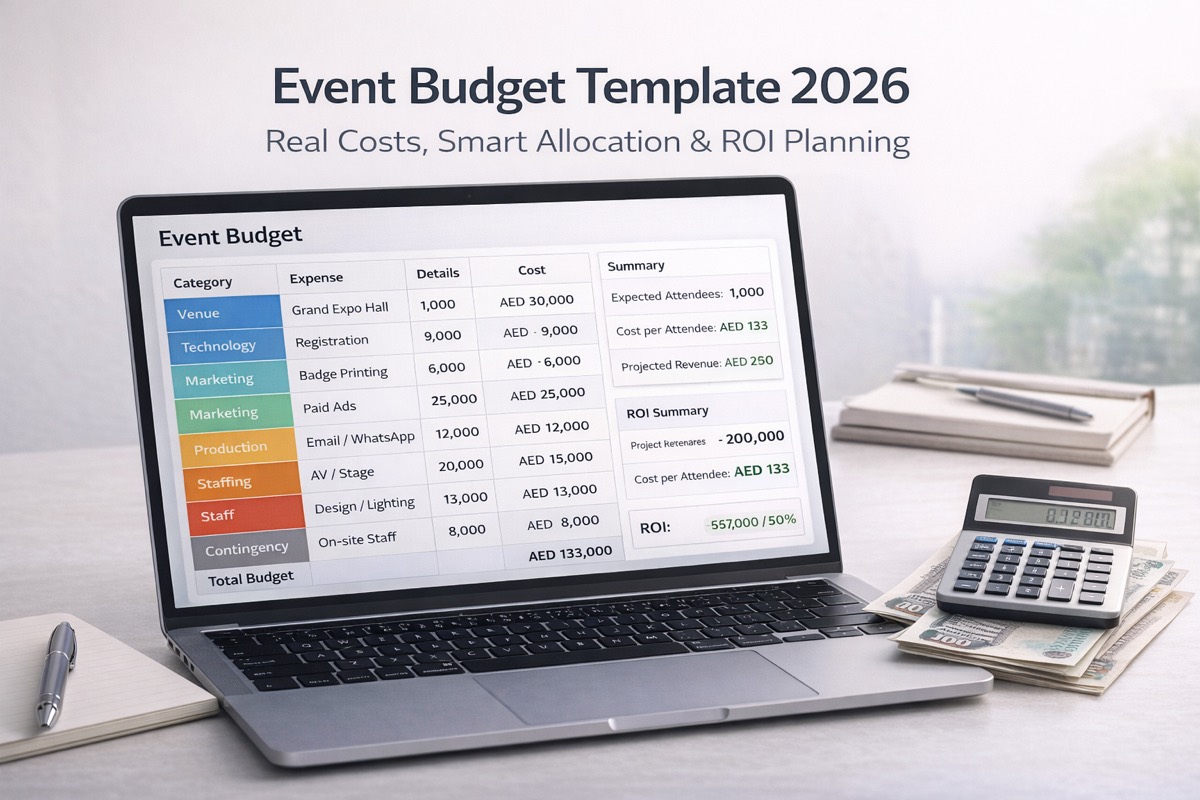
Plan a conference or trade show budget in Excel with editable costs for venue, technology, marketing, production, staffing, and contingency.
Download the free Excel event budget template. No registration required. Open the file in Excel, or import it into Google Sheets.
The workbook includes a $50,000 conference example, editable category shares, actual-cost tracking, budget variance, and cost per attendee. All six example shares add up to 100%. The example uses USD; change the currency label and enter all amounts in your own currency. The sheet does not convert currencies.
How to use the template
- Set your total budget and expected attendee count in the blue input cells.
- Adjust the category shares to match supplier quotes and your event format. Keep the total at 100%.
- Enter actual spending for each category. Enter zero when a category had no spending; leave unknown costs blank. Total actual spending and variance appear when all six categories are filled.
- Review any overspend and the planned cost per attendee before approving more purchases.
The figures below are planning examples, not supplier quotes or industry benchmarks.
What Is an Event Budget
An event budget is not just a list of expenses. It is the financial framework that shapes how the event will actually run.
Many events fail financially because teams:
- underestimate operational costs
- overspend on venue and production
- ignore attendee acquisition costs
- fail to track return on investment
A strong event budget should answer a few practical questions:
- where is the money going?
- which channels are driving registrations?
- what is the cost per attendee?
- which costs can be reduced, automated, or reallocated?
When a budget only records spend after the fact, it is accounting. When it guides decisions before and during execution, it becomes strategy.
Event budget breakdown: a 100% example
This allocation matches the workbook's $50,000, 500-attendee conference example. Change it to suit your event. Include supplier taxes, transaction fees, and other applicable charges consistently in your estimates.
| Category | Share | Planned cost (USD) | Include |
|---|---|---|---|
| Venue and infrastructure | 30% | $15,000 | Venue hire, internet, utilities, setup and teardown |
| Technology | 12% | $6,000 | Registration, check-in, badge printing, event app and reporting |
| Marketing | 24% | $12,000 | Advertising, campaigns, creative and partnerships |
| Production | 16% | $8,000 | AV, stage, signage and attendee experience |
| Staff and operations | 10% | $5,000 | Event staff, logistics and onsite support |
| Contingency | 8% | $4,000 | Reserve for unplanned costs; record only amounts actually used as actual spending |
| Total | 100% | $50,000 | Planned cost per attendee: $100 |
Budget remaining to allocate equals total budget minus planned category costs. The workbook flags an allocation that does not add up to 100%. Positive variance means spending is over the plan; negative variance means it is under.
Event budget formulas
- Category budget: total budget × category share.
- Planned cost per attendee: total planned costs ÷ expected attendees. A zero or missing attendee count has no meaningful per-attendee result.
- Budget variance: actual cost − planned cost, using the same categories and currency.
Conference and trade show budget examples
Conference budget template: 500 attendees
- Venue: $15,000
- Technology: $6,000
- Marketing: $12,000
- Production: $8,000
- Staff: $5,000
- Contingency: $4,000
Total: $50,000
Cost per attendee: $100
Trade show budget example: 1,000 attendees
- Venue: $30,000
- Technology: $10,000
- Marketing: $20,000
- Production: $15,000
- Staff: $8,000
- Contingency: $7,000
Total: $90,000
Cost per attendee: $90
Small business event: 100 attendees
- Venue: $4,000
- Technology: $1,500
- Marketing: $3,000
- Production: $2,000
- Staff: $1,500
- Contingency: $1,000
Total: $13,000
Cost per attendee: $130
These are illustrative organizer budgets, not actual client results or supplier quotes. For a trade show, adapt the workbook categories to cover floor space, stand production, freight, power, lead capture and staff travel. The $90,000 example covers organizing the event; an individual exhibitor needs a separate stand budget.
Hidden Event Costs
This is where many budgets break.
Common hidden costs include:
- last-minute equipment rental
- extra staffing hours
- WiFi upgrades
- payment processing fees
- printing and materials
- platform subscription or support fees
Confirm these items in supplier quotes before signing off the budget.
The point is not to predict every line item perfectly. It is to avoid false confidence.
How to Budget an Event
Not all events should spend in the same way.
Lead generation events
For lead-focused events, invest more in:
- marketing
- registration conversion
- attendee qualification
- check-in speed and data capture
Brand awareness events
For brand-led events, spend more on:
- production quality
- audience experience
- visuals and presentation
- content and speaker environment
Paid-ticket events
For revenue-driven events, focus on:
- balancing marketing spend against ticket price
- improving conversion rates
- tracking cost per attendee carefully
- protecting margin through operational efficiency
Budget allocation should follow event goals. Otherwise, the team may overspend in the most visible areas and underinvest in the areas that actually move results.
How to Reduce Event Costs Without Reducing Quality
Replace manual processes with automation
Manual check-in, spreadsheet-based tracking, and fragmented communication increase both cost and error rate.
Using digital event systems can reduce staffing pressure, improve speed, and eliminate repeated manual tasks.
Improve registration conversion
Higher conversion means lower acquisition cost per attendee.
Useful reading:
Use smarter check-in and hardware setups
Avoid overbuying equipment that does not match the event’s actual arrival flow.
Instead, plan check-in and hardware based on attendee volume, queue design, and complexity:
Automate communication
Email and WhatsApp automation can reduce manual outreach and improve confirmation, reminder, and no-show recovery workflows.
Track cost per attendee in real time
If cost per attendee is too high, you usually need to:
- improve registration conversion
- reduce ineffective marketing spend
- simplify operational tooling
- reallocate budget toward higher-performing channels
Budget vs ROI: What Actually Matters
A successful event is not the cheapest event. It is the most efficient one.
Track metrics such as:
- cost per attendee
- cost per lead
- revenue per attendee
- engagement and retention signals
The goal is not simply to spend less. The goal is to create more value per dollar invested.
Tools That Simplify Event Budgeting
Modern event teams increasingly use connected systems to manage:
- registration
- check-in
- communication
- analytics
That creates:
- better visibility
- better cost control
- better operational decisions
When budget decisions are connected to live event data, planners can adjust faster and reduce waste earlier.
Final Budget Review Checklist
Before sign-off, confirm:
- venue costs are fully documented
- technology costs match the real workflow
- marketing budget has measurable targets
- staffing assumptions are realistic
- hidden costs have been considered
- contingency is included
- ROI metrics are defined in advance
Final Thoughts
Your event budget template is not just a financial document. It is one of the clearest expressions of your event strategy.
When structured properly, it helps you:
- control costs
- allocate resources intelligently
- improve operational efficiency
- create a better attendee experience
- maximize ROI
The strongest event budgets are not built around guesswork or legacy allocations. They are built around goals, real workflows, and measurable outcomes.
Frequently Asked Questions
How do you create an event budget?
Start with event goals, attendee volume, venue, technology, marketing, staffing, logistics, and contingency. Then assign realistic estimates to each category and review them against expected revenue or ROI.
What should be included in an event budget?
An event budget should include venue, infrastructure, registration technology, marketing, production, staffing, logistics, payment-related costs, and a contingency buffer.
How much should I budget for an event?
It depends on event type, city, attendee count, and experience level, but a useful starting point is to estimate cost per attendee and then stress-test venue, marketing, and staffing assumptions before sign-off.
Related reading
- step-by-step event planning
- frameworks for measuring event ROI
- building sponsorship value into the budget
- landing page improvements that lower acquisition waste
If you're planning an event and want to turn budget decisions into a more efficient registration, check-in, and attendee workflow, the next step is aligning your spend with the tools and processes that actually improve outcomes.
Plan registration and check-in costs
Planning a conference, exhibition, or corporate event?
Eventrize helps teams manage registration, check-in, badge printing, communication, and reporting in one connected system so event budgets translate into smoother execution and better ROI.