
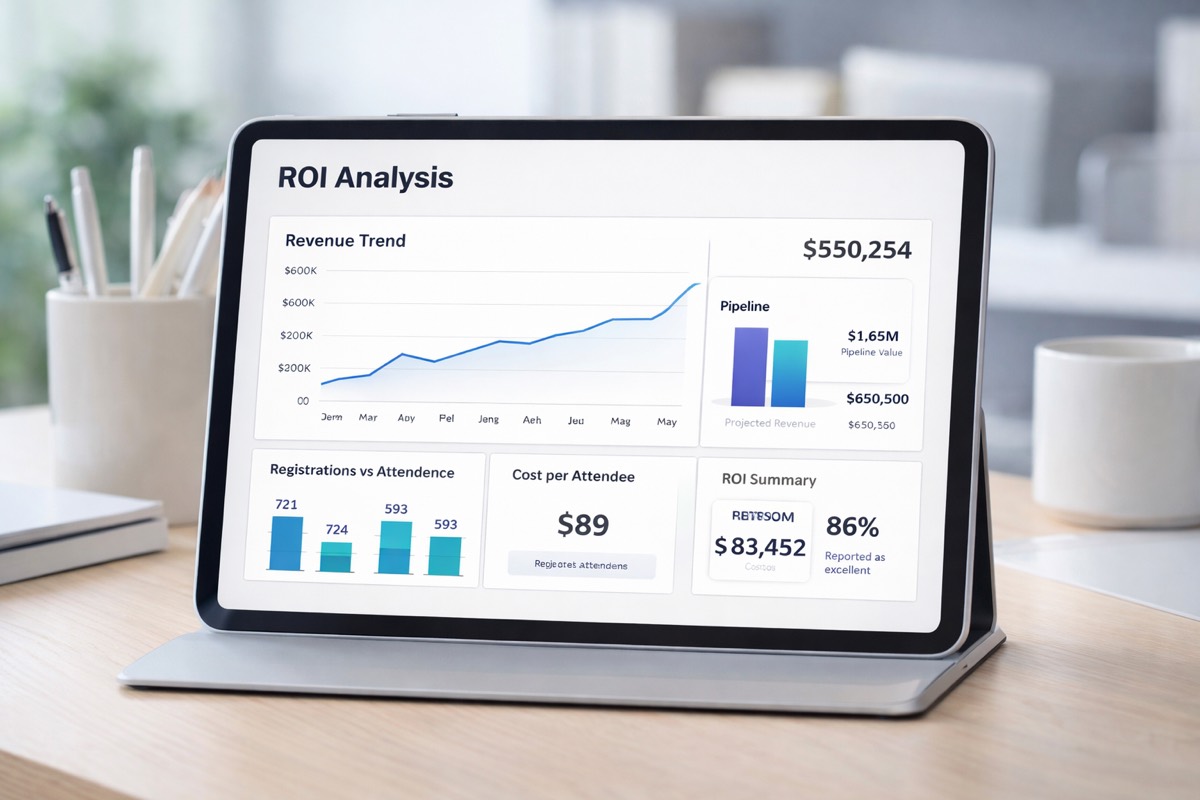
Most event ROI articles make one mistake: they treat ROI as a single financial number calculated after the event is over.
That is not how strong event teams work in 2026.
Modern event ROI starts before registration opens. It is shaped by your goals, your audience, your event format, your sales cycle, your sponsor model, and the quality of the data you capture before, during, and after the event.
If you only measure ticket revenue or attendance, you miss the bigger picture. If you only measure engagement, you miss the commercial outcome. And if you only report one number to leadership, you hide the operational story behind that number.
A more useful way to measure event ROI is to break it into layers:
- commercial return
- pipeline impact
- attendee value
- sponsor value
- first-party data value
This guide gives you a practical ROI framework for organizers, event marketers, agencies, corporate event teams, and operations leaders who need to prove that events create measurable business value.
What Event ROI Really Means
Event ROI is the business value created by an event compared with the total investment required to produce it.
That value can come from:
- direct ticket revenue
- sponsorship income
- qualified pipeline
- faster deal movement
- customer expansion
- stronger retention
- better attendee engagement
- more accurate first-party data
- higher partner or exhibitor satisfaction
So the right question is not just, “Did the event make money?”
The better question is, “What business value did the event create, and was that value worth the investment?”
Different event types create value in different ways.
A paid conference may generate direct revenue.
A free B2B summit may generate qualified pipeline.
A customer event may drive retention and expansion.
An exhibition may create sponsor and exhibitor value.
A leadership roundtable may influence large deals that close months later.
That is why event ROI needs a framework, not just a formula.
Why Most Teams Measure Event ROI Wrong
Event ROI reporting usually fails at the reporting stage because it already failed at the planning stage.
Teams often launch an event first and decide what success looks like later. That creates weak reporting because the data being collected is not connected to a clear business outcome.
The most common problems are:
- too much focus on vanity metrics
- no agreement on primary success metrics
- disconnected registration, check-in, and reporting systems
- no attribution model for leads, meetings, or pipeline
- no sponsor success measurement
- no post-event follow-up framework
This is why many post-event reports sound impressive but do not help leadership make decisions.
For example:
- 2,000 registrations sounds strong, but how many were qualified?
- 1,400 attendees sounds good, but how many actually engaged?
- 20,000 email opens sound positive, but did they lead to action?
- a high satisfaction score is useful, but did it create pipeline, retention, or revenue?
Good event ROI reporting connects activity to outcomes.
The 5-Layer Event ROI Framework
To make ROI reporting more practical, use a five-layer framework.
Layer 1: Financial ROI
This is the most direct form of return.
Measure:
- ticket revenue
- sponsorship revenue
- exhibitor revenue
- upsell revenue
- merchandise or add-on sales
- total event cost
- net return
Best for:
- paid conferences
- ticketed workshops
- exhibitions with exhibitor packages
- events with strong commercial monetization
Layer 2: Pipeline ROI
This is essential for B2B events.
Measure:
- marketing qualified leads
- sales qualified leads
- meetings booked
- opportunities created
- pipeline influenced
- pipeline sourced
- closed-won revenue linked to attendees
- sales cycle acceleration
Best for:
- demand generation events
- executive roundtables
- industry summits
- product launches
- trade shows
Layer 3: Attendee Value ROI
This measures how valuable the event was to the audience and how that value connects to your business goals.
Measure:
- attendance rate
- session attendance
- repeat session participation
- app engagement
- survey completion
- meeting participation
- content downloads
- post-event return intent
- product interest signals
Best for:
- conferences
- multi-track events
- customer education events
- community-led events
Layer 4: Sponsor ROI
This matters for exhibitions, conferences, and partner-led events.
Measure:
- booth visits
- badge scans
- qualified conversations
- meetings completed
- sponsor lead quality
- content engagement
- sponsor renewal interest
- post-event lead handoff quality
Best for:
- sponsor-backed events
- exhibitions
- conferences with partner packages
- industry summits
Layer 5: Data ROI
This is one of the most underrated ROI layers and one of the strongest strategic differentiators for modern event programs.
Measure:
- first-party data completeness
- segment enrichment
- intent signals captured
- source attribution quality
- attendee interest mapping
- session preference data
- sponsor interaction data
- post-event remarketing quality
- CRM enrichment
Best for:
- any event where long-term audience value matters
- B2B events
- recurring event programs
- brand-owned event ecosystems
This layer matters because events are no longer only experience channels. They are also data engines. A strong event can improve not just one campaign, but future segmentation, targeting, follow-up, account prioritization, and sponsor value.
Event ROI Formula
The basic formula is still useful:
ROI = (Return - Investment) / Investment x 100
Example:
- Total event spend: $60,000
- Total attributed return: $105,000
ROI = ($105,000 - $60,000) / $60,000 x 100
ROI = 75%
That formula works when returns are clear and direct.
But for many events, the bigger challenge is not the formula. It is deciding what counts as return.
That is why you should define return differently depending on the event model.
How to Define Return by Event Type
For a paid event
Return may include:
- ticket sales
- sponsor revenue
- exhibitor fees
- premium upgrades
For a B2B lead generation event
Return may include:
- qualified pipeline created
- meetings booked with target accounts
- influenced opportunities
- closed-won revenue within an attribution window
For a customer event
Return may include:
- renewal influence
- upsell opportunities
- adoption signals
- customer health improvements
For an exhibition
Return may include:
- exhibitor retention
- sponsor satisfaction
- lead handoff volume
- paid floor space growth
For a recurring event series
Return may also include:
- audience growth efficiency
- lower cost per attendee over time
- stronger first-party audience data
- better campaign performance in future events
How to Measure Event ROI Before, During, and After the Event
Strong ROI reporting does not happen in one report at the end. It happens in phases.
Before the event
At this stage, measure readiness and acquisition efficiency.
Track:
- registration volume
- registration conversion rate
- source performance
- cost per registration
- target audience mix
- invite acceptance rate
- meeting requests
- session preference signals
- early sponsor engagement
This is where you establish the baseline for ROI.
If your cost per registration is too high before the event, or the wrong audience is registering, your ROI problem has already started.
During the event
This is where operational and behavioral signals matter.
Track:
- check-in rate
- attendance rate
- no-show rate
- walk-in volume
- session attendance
- session drop-off
- badge scans
- booth interactions
- app usage
- survey completion
- meeting completion
- content engagement
- dwell time by area or session type
This is where connected event data becomes especially powerful.
Registration data tells you who intended to attend.
Check-in data tells you who actually arrived.
Engagement data tells you what they cared about.
Together, those signals create much stronger ROI reporting.
After the event
This is where commercial proof becomes clearer.
Track:
- qualified leads delivered
- follow-up meeting conversion
- pipeline influenced
- pipeline created
- closed-won revenue
- sponsor lead quality
- attendee satisfaction
- repeat attendance intent
- content re-engagement
- customer expansion or retention indicators
This phase is where many event teams lose visibility because the event system and sales or marketing systems do not connect properly.
A More Useful Way to Report Event ROI
Instead of sending one generic event report to everyone, create stakeholder-specific reporting.
For leadership
Show:
- total spend
- total return
- ROI by event goal
- top business outcomes
- strategic recommendation
For marketing
Show:
- channel performance
- registration conversion
- cost per registration
- cost per qualified attendee
- engagement by campaign source
For sales
Show:
- meetings booked
- opportunities influenced
- pipeline by attendee segment
- account engagement
- follow-up conversion
For operations
Show:
- check-in speed
- attendance rate
- no-show rate
- staffing efficiency
- session capacity performance
For sponsors
Show:
- booth interactions
- qualified scans
- sponsor session engagement
- meetings completed
- follow-up value
One report rarely serves every audience well. Good event ROI communication depends on role-specific clarity.
Event KPIs to Track
If you want a stronger ROI model, focus on metrics that connect action to value.
Commercial metrics
- total revenue
- net revenue
- cost per attendee
- revenue per attendee
- sponsor revenue
- exhibitor revenue
Pipeline metrics
- leads sourced
- leads influenced
- meetings booked
- qualified opportunities
- pipeline value
- revenue influenced
Engagement metrics
- attendance rate
- check-in completion
- session attendance per topic
- app engagement
- meeting participation
- survey completion
Efficiency metrics
- cost per registration
- cost per qualified attendee
- cost per meeting
- cost per opportunity
- no-show rate
- staffing cost per attendee
Strategic metrics
- audience data quality
- sponsor renewal likelihood
- repeat attendance intent
- content re-engagement
- retention or expansion indicators
Common Event ROI Mistakes to Avoid
Mistake 1: Reporting registrations as success
Registrations show interest. They do not prove value on their own.
Mistake 2: Ignoring no-show rate
A large registration number can hide a weak actual attendance outcome.
Mistake 3: Measuring only direct revenue
Many events create value through pipeline, retention, or sponsor outcomes, not ticket sales alone.
Mistake 4: Separating registration from check-in reporting
If registration and attendance data live in different places, attribution gets weaker.
Mistake 5: Not tracking sponsor outcomes
Sponsors do not just want visibility. They want leads, meetings, and measurable value.
Mistake 6: Failing to define attribution windows
For many B2B events, revenue influence happens weeks or months later. Without an agreed measurement window, ROI gets underreported.
Mistake 7: Treating all attendees as equal
A target-account attendee may be worth far more than ten low-fit attendees. Segment quality matters.
Mistake 8: Measuring only what is easy
Easy metrics are not always useful metrics. Good event ROI often requires operational, behavioral, and commercial data together.
A Practical Example of Smarter ROI Reporting
Let’s say a B2B summit had these results:
- Total spend: $85,000
- Registrations: 1,200
- Attendees checked in: 860
- Qualified attendees: 340
- Meetings booked: 96
- Opportunities influenced: 28
- Pipeline influenced: $640,000
- Sponsor revenue: $35,000
- Closed-won revenue within 90 days: $140,000
A weak report would say:
“The event had 1,200 registrations and 860 attendees.”
A stronger report would say:
“The event generated 340 qualified attendees, influenced $640,000 in pipeline, drove 96 booked meetings, and returned $140,000 in closed-won revenue within 90 days, in addition to $35,000 in sponsor revenue.”
That is a completely different conversation.
Why Event Data Quality Is Now Part of ROI
In 2026, event ROI is not only about outcomes from one event. It is also about what the event teaches you about your audience.
Good event data helps you answer:
- which audience segments convert best
- which channels bring high-value attendees
- which sessions attract real buying interest
- which exhibitors or sponsors generated meaningful engagement
- which attendees should enter fast follow-up sequences
- which accounts showed repeated intent signals
That makes the event valuable beyond the event itself.
A well-run event improves:
- segmentation
- nurture campaigns
- sponsor sales
- sales prioritization
- future event targeting
- content planning
This is why data ROI deserves its own category.
How Eventrize Supports ROI Measurement
Event ROI gets stronger when your systems are connected.
If registration happens in one tool, check-in in another, communication in another, and analytics somewhere else, reporting becomes slower and less reliable.
A connected setup helps teams track:
- source-to-registration performance
- registration-to-attendance conversion
- check-in accuracy
- attendee engagement signals
- sponsor interaction data
- operational efficiency
- post-event follow-up readiness
The value is not just running the event. The value is making the event measurable.
When registration, check-in, communication, and analytics work together, it becomes easier to prove:
- what drove attendance
- what drove engagement
- what created pipeline
- what justified the budget
Event ROI Dashboard
Executive summary
- total spend
- total return
- overall ROI
- top 3 outcomes
- recommendation for future events
Commercial view
- ticket revenue
- sponsor revenue
- exhibitor revenue
- net return
- revenue per attendee
Audience view
- registrations
- attendance rate
- no-show rate
- attendee quality mix
- repeat attendance intent
Engagement view
- session attendance
- app usage
- meetings completed
- survey response
- sponsor interactions
Pipeline view
- qualified leads
- opportunities influenced
- pipeline value
- meetings booked
- closed-won revenue
Data view
- first-party data completeness
- source attribution quality
- segment enrichment
- content interest signals
- sponsor lead quality
Final Thoughts
The best event teams in 2026 do not wait until the event is over to ask whether it worked.
They define ROI early.
They track the right signals across the full event journey.
They connect operational data to commercial outcomes.
And they report value in a way leadership can actually use.
That is the real shift.
Event ROI is no longer just a finance metric. It is a planning model, an operations model, a marketing model, and a growth model.
When you treat it that way, your event program becomes easier to defend, easier to improve, and much more valuable over time.
Frequently Asked Questions
How do you calculate event ROI?
The standard event ROI formula is (Return - Investment) / Investment x 100, but the real work is defining return correctly based on revenue, pipeline, sponsor value, and attendee outcomes.
What metrics should be used to measure event ROI?
Strong event ROI measurement usually includes revenue, pipeline influenced, cost per attendee, cost per lead, attendance rate, qualified attendees, sponsor ROI, and post-event reporting metrics tied to business goals.
How do free events measure ROI?
Free events usually measure event ROI through pipeline influenced, meetings booked, qualified attendees, customer retention signals, sponsor value, and first-party data quality rather than ticket revenue alone.
Why is data quality part of event ROI?
Because event data improves segmentation, follow-up, sales prioritization, sponsor reporting, and future event performance. That creates long-term value beyond one event day.
Related reading
- budget planning that supports ROI
- post-event survey questions that improve reporting
- sponsor strategy and sponsor ROI
If you want to improve event ROI in a measurable way, the next step is not just reporting better after the event. It is capturing cleaner registration, attendance, engagement, and sponsor data throughout the full event journey.
CTA
Planning a conference, summit, exhibition, or sponsor-backed event?
Eventrize helps teams connect registration, check-in, communication, badge printing, and reporting so event ROI becomes easier to measure and easier to improve.