Event Registration Bot: How AI Reduces Drop-Off and Speeds Up Sign-Ups in 2026
Learn how an event registration bot helps organizers answer attendee questions instantly, reduce registration friction, qualify leads, and connect sign-ups to WhatsApp, QR check-in, and badge printing.
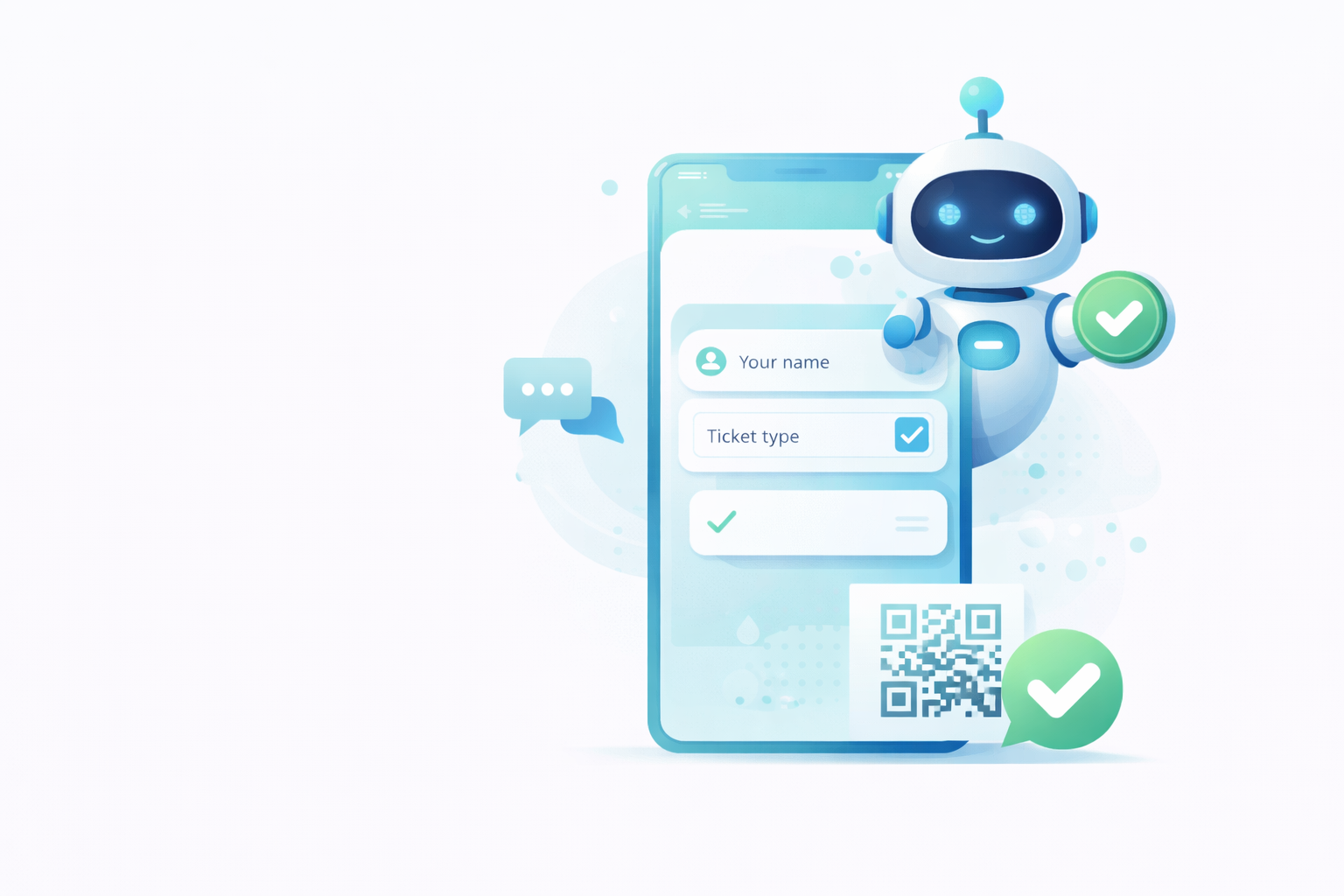
Event Registration Bot: How AI Reduces Drop-Off and Speeds Up Sign-Ups in 2026
Event registration is often the first real experience an attendee has with your event. If that experience feels slow, confusing, or overly manual, people drop off before they ever reach your venue.
That is why more organizers are moving beyond static forms and adding guided, AI-powered registration journeys. An event registration bot helps attendees get answers in real time, complete sign-up with less friction, and move more smoothly from registration to confirmation, QR code check-in, and onsite access.
For organizers, that means fewer repetitive questions, cleaner registration data, and a faster path from interest to attendance.
What is an event registration bot?
An event registration bot is a conversational tool that helps attendees register for an event by guiding them through the sign-up process step by step.
Instead of leaving users alone on a long registration form, the bot can:
- answer common registration questions
- explain ticket or attendee categories
- collect attendee details in a guided flow
- route users to the right registration path
- trigger confirmations and follow-ups
- support handoff into QR check-in or badge printing workflows
In simple terms, it acts like a smart registration assistant that helps people complete registration with less confusion and less delay.
Why traditional event registration flows lose attendees
Most registration drop-off does not happen because people are not interested. It happens because the process creates friction.
Common reasons include:
1. Too many fields too early
Long forms ask attendees to do too much before they feel confident enough to continue. When the form looks heavy, users postpone it or leave.
2. No instant answers
Attendees often have simple questions before they submit:
- Which ticket type should I choose?
- Is this event open to the public?
- Can I register as media, exhibitor, sponsor, or VIP?
- Will I receive a QR code?
- Can I check in using my phone?
If those answers are not available immediately, the registration journey slows down.
3. Weak mobile experience
A large share of event discovery and sign-up now happens on mobile. Static forms that feel manageable on desktop often become frustrating on smaller screens.
4. Confusing attendee categories
Many events do not have one audience. They have visitors, delegates, exhibitors, speakers, sponsors, media, buyers, and staff. When the right path is not obvious, people either abandon the form or submit the wrong information.
5. Slow manual follow-up
Some teams still rely on staff to clarify categories, resend information, or answer repetitive questions after the user already tried to register. That adds delay to a moment when speed matters.
How an event registration bot works
A strong event registration bot usually follows a simple but effective flow.
Step 1: It answers registration questions instantly
Before asking for data, the bot can explain the event, ticketing options, eligibility rules, timings, venue details, and what happens after registration.
This matters because users often need confidence before they commit.
Step 2: It guides attendees through sign-up
Instead of presenting everything at once, the bot can collect details progressively. That makes the process feel lighter and easier to complete, especially on mobile.
Step 3: It qualifies and routes users
Not every attendee should see the same registration flow. A registration bot can direct different audiences into the right path based on role, company type, event interest, or invitation status.
For example:
- visitors follow one path
- exhibitors follow another
- VIPs or hosted buyers go through qualification
- media applicants provide additional details
Step 4: It triggers confirmation and follow-up
Once registration is complete, the system can send confirmation messages, reminders, and next steps through email or WhatsApp.
Step 5: It connects to event operations
The real value comes when registration is not isolated. A well-connected registration bot can feed data into your event platform so the attendee journey continues into QR code issuance, onsite check-in, badge printing, and reporting.
Event registration bot vs traditional registration form
This is the real question many organizers ask.
A registration form is still useful. For simple events with one audience and very little complexity, a standard form may be enough.
But an event registration bot becomes much more valuable when the registration journey needs guidance.
A traditional form works best when:
- the event has one clear audience
- the form is short
- there are few pre-registration questions
- no qualification is required
- attendees already understand the process
A registration bot works best when:
- attendees need help before they submit
- the event has multiple audience types
- qualification is part of registration
- the user journey is mobile-first
- WhatsApp or messaging-based registration matters
- the team receives many repetitive registration questions
- organizers want a smoother link between sign-up and check-in
In many cases, the best setup is not bot or form.
It is bot plus form.
The form remains the structured data layer, while the bot acts as the conversational guide that helps attendees complete it correctly.
The biggest benefits of an event registration bot
1. Lower registration friction
The main benefit is simple: it makes registration easier.
When users can ask questions and get guided answers during the process, they are less likely to stall or abandon the page.
2. Faster response times
An event team cannot answer every registration question instantly, especially outside business hours. A registration bot gives attendees immediate help at the moment they need it.
3. Better lead qualification
Not every event wants every registration to be treated the same way. Some events need approval logic, audience segmentation, or different journeys for different stakeholders.
A bot helps qualify users before bad data reaches your CRM or registration dashboard.
4. Better mobile registration experience
Typing into a conversational flow often feels easier than navigating a long, dense form on a phone. That matters for paid campaigns, WhatsApp journeys, and social-driven traffic.
5. Less manual workload for organizers
The same questions come up again and again:
- How do I register?
- Where is my confirmation?
- Can I update my details?
- Do I get a QR code?
- Which category should I select?
A bot helps absorb repetitive support so the team can focus on exceptions instead of routine tasks.
6. Smoother handoff to onsite check-in
Registration quality affects onsite speed. When attendee records are cleaner and confirmations are delivered properly, QR code scanning and badge printing become much easier on event day.
Where event registration bots work best
An event registration bot is especially useful when the event is not simple.
Conferences
Conferences often involve multiple attendee groups, paid and unpaid access, approval paths, and agenda-driven messaging. A registration bot helps reduce confusion early.
Exhibitions and trade shows
Exhibitions usually include visitors, exhibitors, sponsors, speakers, buyers, media, and VIPs. Routing matters. A bot can direct each segment into the right flow.
Corporate events
For internal or invitation-led events, a bot can support RSVP collection, employee verification, personalized messaging, and event reminders.
High-volume public events
When many people are trying to register in a short time, speed and support become critical. A guided registration flow helps reduce the support burden.
UAE and GCC events
Many events in the UAE and GCC serve multilingual, mobile-first audiences. A conversational registration journey can feel more accessible than a rigid form, especially when paired with messaging channels and onsite QR workflows.
What features should organizers look for in an event registration bot?
Not every bot is worth deploying. Some are just chat widgets with no operational value.
Look for these features:
Guided registration flows
The bot should do more than answer FAQs. It should actively help users progress through registration.
Audience routing and qualification
The bot should support different user paths for visitors, exhibitors, speakers, sponsors, media, and VIPs.
CRM and registration platform integration
Data should flow into your existing event platform, not sit inside a disconnected chatbot.
Confirmation and reminder automation
The registration bot should support follow-up messages so the attendee journey continues after sign-up.
WhatsApp-friendly experience
If your audience is active on messaging channels, registration should not be limited to a traditional website-only experience.
QR code and check-in readiness
The registration process should support the next operational step: confirmation, QR issuance, and fast onsite validation.
Analytics and optimization
A useful registration bot should show where users drop off, what questions come up most often, and which paths lead to completion.
Human fallback
Even the best bot should allow escalation when the case is too specific, too sensitive, or too complex.
How an event registration bot improves QR check-in and badge printing
Many organizers treat registration and check-in as separate problems.
They are not.
Bad registration creates bad check-in.
When attendees register through the wrong category, fail to receive confirmation, arrive with incomplete data, or need manual correction onsite, queues grow fast.
A better registration flow improves everything downstream.
Here is how:
Cleaner attendee records
When users are guided into the correct path, staff spend less time fixing mistakes at the venue.
Better confirmation delivery
If the workflow is connected properly, attendees can receive the right confirmation and QR code before event day.
Faster scanning onsite
When each attendee record is matched correctly, QR code validation becomes faster and more reliable.
Better badge printing readiness
Badge printing works best when the registration data is already structured and accurate. Guided collection up front reduces onsite troubleshooting.
Better reporting
When registration and check-in are connected, organizers get a stronger view of the full attendee journey from sign-up to actual attendance.
When should you use a registration bot instead of a form?
Use a standard form when your event is simple.
Use a registration bot when your event journey needs explanation, qualification, or conversational support.
A few practical signals that you are ready for a registration bot:
- your team keeps answering the same registration questions
- you have multiple audience types
- the form is causing drop-off
- mobile traffic is strong but completion is weak
- you want to support WhatsApp-led journeys
- registration needs to connect cleanly to QR code check-in
- you want fewer manual corrections onsite
If several of those are true, a registration bot is no longer a nice extra. It becomes part of the conversion path.
Best practices for publishing this kind of content
To make this post rank and convert well, keep it focused on real buyer questions rather than generic AI hype.
That means:
- define the problem clearly
- explain where a bot helps and where a normal form is still enough
- show how the workflow connects to real event operations
- keep the language practical, not abstract
- include FAQ sections for long-tail search coverage
- link naturally to relevant product pages
For Eventrize, the strongest internal links in this article are:
Final takeaway
An event registration bot is not just a chatbot on a website.
Used properly, it becomes a guided registration layer that helps attendees complete sign-up faster, reduces support load for organizers, improves qualification, and creates a smoother path into WhatsApp follow-up, QR code check-in, and badge printing.
That is what makes it valuable in 2026.
Not because it sounds advanced, but because it solves a real problem: too many event registration journeys still lose people before the event even begins.
If your team wants fewer drop-offs, faster responses, and cleaner event-day operations, an event registration bot is one of the strongest upgrades you can make to the registration experience.
Frequently Asked Questions
What is an event registration bot?
An event registration bot is a conversational tool that helps attendees complete sign-up by answering questions, collecting details, and guiding them through the registration journey.
How is a registration bot different from a normal registration form?
A normal form collects data. A registration bot helps attendees understand the process, choose the right path, and complete sign-up with less friction.
Can an event registration bot work with WhatsApp?
Yes. A registration bot can support messaging-led journeys, including WhatsApp-based registration and follow-up flows.
Can a registration bot connect to QR code check-in?
Yes. When integrated properly, registration data can flow into confirmation, QR code issuance, and onsite check-in workflows.
Is a registration bot useful for exhibitions and conferences?
Yes. It is especially useful for events with multiple attendee groups, qualification logic, or high support volume before the event.
Does a registration bot replace a registration form?
Not always. In many cases, the best setup is a bot working alongside a form, helping attendees complete the process correctly rather than replacing forms entirely.